Your aging parent needs help. There's just one problem… they keep saying, "I'm fine."
Discover a calm, step-by-step way to help your parent get the right care at the right time — without endless fights, guilt, family drama, or lying awake wondering if you're making a terrible mistake.
Even if they've already said:
“I'm never leaving this house.”
“You're trying to put me away.”
“I don't need help.”
“Stop worrying about me.”
The Peaceful Transition Blueprint — a complete digital reference system for navigating the senior-care journey, from the first hard conversation to choosing care, paying for it, making the move, and getting your life back afterward.
It usually starts with something small.
Maybe Dad fell. He says it was nothing.
Maybe Mom left the stove on. She laughs it off.
Maybe there are three days of pills sitting in the organizer that should be empty.
Maybe the mail is stacking up. The fridge looks bare. The house isn't as clean as it used to be.
Or you call at 8:00 at night… and nobody answers.
So you call again. And again. Your stomach tightens.
Then finally the phone rings. "Hello?"
And there they are. Perfectly fine.
Meanwhile, your heart is pounding out of your chest. And you tell yourself: something has to change.
So the next time you visit, you bring it up. Carefully. You try to sound calm. You mention that maybe it would be smart to "look at some options."
And before you've even finished the sentence… their face changes. "Absolutely not."
You try logic. They get defensive. You explain how worried you are. They say you're overreacting.
You mention assisted living. They hear nursing home.
You say you're trying to help. They hear: "You want to take my life away."
And twenty minutes later, you're both angry. You're both hurt. Nothing has changed — except now it's even harder to bring up next time.
Here's the part most families get wrong…
You may think the problem is that your parent is stubborn. Or unreasonable. Or in denial. But what if the real problem isn't the resistance itself?
What if it's the way the resistance is being approached?
When an aging parent feels like their home, their freedom, their money, their routine, their car, their privacy, and their right to make their own choices are all being threatened at once… pushing harder doesn't always create action. Sometimes it creates a bigger wall.
And suddenly a loving child and a scared parent are standing on opposite sides of a fight neither one wanted.
That's why the first part of this Blueprint doesn't begin with facilities. It doesn't begin with Medicare. It doesn't begin with moving boxes. It begins with something more important:
How to get back on the same team.
You'll discover:
- The hidden fear that may be sitting underneath "I'm never moving" — and why arguing with the words can miss the real issue.
- Why dumping more facts on a resistant parent can make them dig in harder, even when every fact you share is true.
- The subtle difference between pushing someone toward care and guiding them toward a decision they still feel part of.
- How to begin the conversation without making Mom or Dad feel like the verdict has already been decided.
- What to say when they accuse you of trying to take their money, steal their house, control their life, or "put them away."
- How to know when the time for gentle planning has become the time for faster action.
But that's only the beginning. Because even when your parent starts listening, you still have to answer the questions nobody prepared you for.
What care do they actually need?
How much is this really going to cost? Who pays for it?
How do you know whether a facility is actually good?
What if your brother says Mom is fine? What if your sister thinks you waited too long?
What do you do on moving day?
And what happens when Mom calls three days later crying… "Please come get me."
That's the real senior-care journey. And almost nobody hands families a map for it. Until now.
Google gives you information. What you need is a decision.
That's the trap. When you're scared, you research.
One article says assisted living. Another says home care. Someone on Facebook tells you Medicare will pay. A friend says it won't.
One facility tells you Mom is perfect for assisted living. Another says she needs memory care. Your sibling thinks you're overreacting. Your spouse thinks you've waited too long. Your parent wants the whole subject dropped.
And now you've got 37 browser tabs open… but you still don't know what to do Monday morning.
That's because this isn't one decision. It's a chain of decisions. And getting the early ones wrong can make every decision after that harder.
That's why The Peaceful Transition Blueprint isn't meant to be another giant book you read once and forget. It's designed to be the thing you pull back out when the next decision hits.
- Conversation tonight? Open the conversation section.
- Family blow-up tomorrow? Open the family section.
- Facility tour Saturday? Bring the tour tools.
- Money meeting next week? Use the financial framework.
- Moving day coming? Follow the transition plan.
- Parent settled in but you're still waking up in panic? There's a section for that, too.
"I kept watching good families walk into the same crisis completely unprepared."
My name is Louis van Tonder. I served as Marketing Director for a 180-resident retirement community that offered the full continuum of senior care — from independent living, to assisted living, to memory care, to skilled nursing.
But "Marketing Director" doesn't really describe what the job became. Because families didn't walk through the door thinking about marketing. They walked in scared.
A daughter would get a call from the hospital. Mom had fallen again. Discharge was coming fast. Going home alone wasn't safe. And suddenly the family had days — not months — to make decisions they had never made before.
I sat with sons trying to convince fathers who swore they'd never leave home. I watched siblings fight over who was doing too much and who wasn't doing anything. I walked families through facility tours and watched them focus on the beautiful lobby while missing the things that mattered far more.
I watched people panic over costs. Second-guess contracts. Feel sick with guilt. Wonder if they were abandoning their parent. And ask some version of the same question:
"How do I know I'm doing the right thing?"
After seeing this play out over and over, I noticed something. The families who handled the transition best weren't always the families with the easiest parent. They weren't always the ones with the most money. They weren't always the ones who lived nearby.
They simply had something most families didn't: a framework.
They knew how to talk about care without turning the conversation into a showdown. They knew the difference between levels of care. They went on tours knowing what they were trying to find out. They had a clearer picture of the money. They knew the next step. And because they had a process, they didn't have to invent a plan while standing in the middle of a crisis.
That stayed with me. Because I knew I couldn't sit beside every family at the kitchen table. I couldn't attend every sibling meeting. I couldn't walk through every tour. And I couldn't answer the phone every time someone got "the call."
So I did the next best thing. I took the frameworks, questions, warning signs, checklists, scripts, and lessons families needed most, and organized them into one clear system.
I call it The Peaceful Transition Blueprint.
This isn't a book about "putting your parents in a home."
It's a guide to making a hard season of life safer, calmer, clearer, and more humane.
The goal isn't to force your parent into anything. The goal is to help you answer:
What does this person I love actually need now?
Then figure out the best way to get there — while protecting as much dignity, choice, safety, family peace, and financial stability as possible.
The Blueprint walks you through the journey in order. But you don't have to read it in order.
If your biggest problem today is Dad refusing to talk… start there.
If Mom is already willing but you don't know what kind of care she needs… jump there.
If you've already scheduled tours… open that section.
If you've chosen the community and moving day is next week… skip right to transition planning.
Think of this less like a book, and more like having a senior-care reference binder sitting beside you whenever the next question comes up.
Imagine knowing what to do before the next crisis hits.
Picture this. The phone rings at night. You still care. You still worry. But you don't instantly spin into the same helpless panic.
Because you've already checked the major safety risks. You've organized the information you'll need. You know which warning signs matter. You've started the conversation. Your siblings know their roles. You've discussed the money. You have a short list of options. And if something changes, you know where to look next.
Or imagine sitting across from Dad. You bring up care. Your heart is racing because you've had this fight ten times. But this time you don't begin by telling him what he "has to do." You know what fear you're listening for. You know what words make things worse. You know how to keep him involved in the process.
The conversation may still be hard. But for the first time… hard doesn't have to mean hopeless.
Now imagine walking through a senior community. The salesperson is friendly. The lobby is beautiful. But you're not hypnotized by the chandelier. You're watching. Listening. Asking. Comparing. You know what deserves a second look, and what deserves a harder question.
That's what clarity feels like. Not knowing the future. Not controlling everything. Just knowing:
"I have a plan. I know what to look for. And I know my next step."
Here's what's inside The Peaceful Transition Blueprint
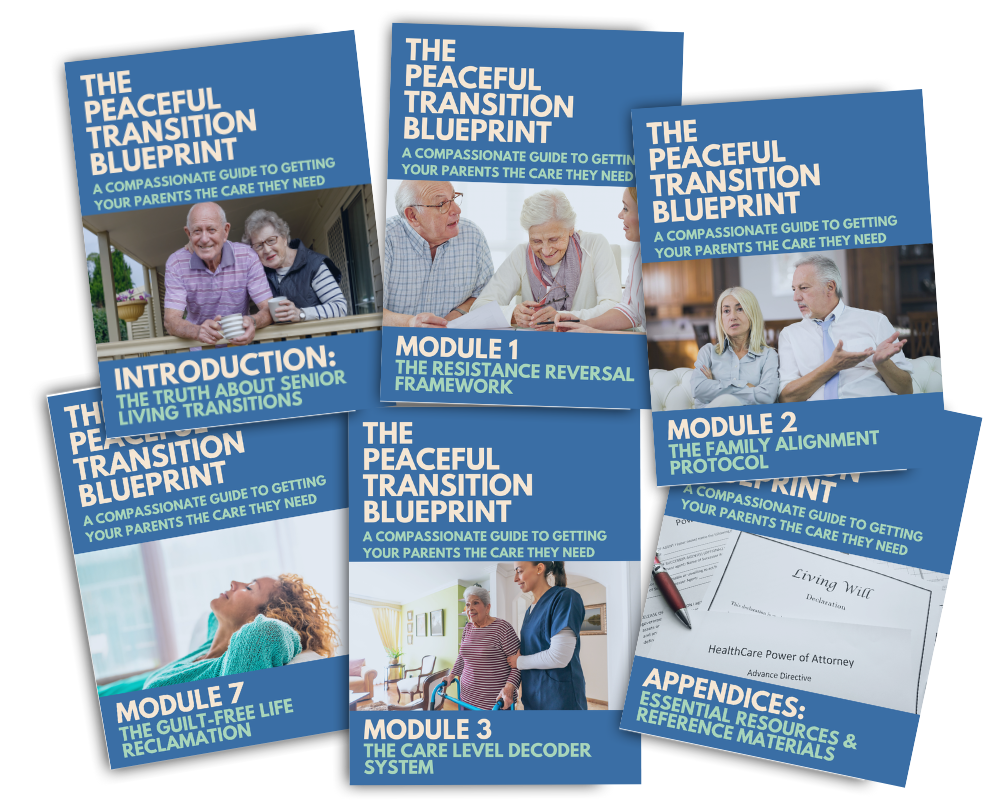
The Resistance Reversal Framework
This is where you begin if Mom or Dad says "I'm fine," "I'm never moving," "Leave me alone," or "You're trying to control me." You'll learn how to look beneath the surface of resistance so you can address the fear driving it instead of simply arguing with the words coming out of their mouth.
- Why an aging parent can resist help even when the safety problems seem obvious to everyone else.
- How loss of independence, identity, control, privacy, and home can fuel the "NO."
- The difference between creating more pressure and creating more buy-in.
- How to move away from an "us versus them" fight and toward a problem you solve together.
The Family Alignment Protocol
One sibling thinks Dad needs help yesterday. Another says you're being dramatic. Someone lives three states away with plenty of opinions. Someone else lives ten minutes away and is exhausted from doing everything. Old family roles come roaring back, and suddenly you're not just solving senior care — you're reliving Thanksgiving 1998.
- Run a more productive family meeting.
- Divide responsibilities more fairly.
- Reduce side conversations and mixed messages.
- Stop old resentment from hijacking current decisions.
- Keep everyone moving toward the same goal: the parent's welfare.
The Care Level Decoder System
Independent living? Assisted living? Memory care? Skilled nursing? Home care? Most families aren't taught the difference until they're suddenly expected to choose one. This module helps you make sense of the care continuum and look at what your parent can safely do today.
- Daily living needs and how much support your parent truly needs.
- Mobility and fall risk.
- Medication help.
- Cognitive changes and safety issues.
So you're less likely to choose care that's too restrictive — or discover too late that the care you chose isn't enough.
The Financial Clarity System
A quoted monthly price is rarely the only number that matters. Care levels. Medication help. Community fees. Transportation. Added services. And then the bigger questions: What does Medicare cover? What about Medicaid? Which assets matter? How long will the money last? Does the house have to be sold?
- The real components of senior-care costs.
- Funding sources and assets.
- Medicare versus Medicaid.
- Potential hidden charges and long-term affordability.
- Questions to ask before signing.
Facility Selection & Tour Mastery
Facilities know how to give tours. The model apartment looks perfect. The dining room shines. The amenities sound wonderful. But your parent isn't moving into the brochure — they're moving into the day-to-day reality of that community. This module teaches you how to research, tour, observe, question, compare, and spot warning signs before committing.
- What to investigate before you ever schedule the tour.
- What to watch once you're inside.
- Which questions reveal far more than "What activities do you offer?"
- How to compare communities more objectively.
- What should make you slow down before signing.
The Peaceful Transition Timeline
Even after you've chosen the right care, you still have to make the transition. And for an older adult leaving a familiar home, that can be emotional and disorienting. This module walks you through the preparation, the move, and the early adjustment period.
- How to prepare before moving day.
- How to reduce avoidable stress during the move.
- How to approach the critical settling-in period.
- What to do when the "come get me" calls begin.
- How to stay involved without making adjustment harder.
The Guilt-Free Life Reclamation
Maybe your parent is finally safe. But your nervous system hasn't gotten the memo. You're still checking your phone. Still expecting an emergency. Still feeling guilty when you spend time with your own family. Still wondering whether you're visiting enough. This module helps you build a more sustainable way to stay involved.
- Loving boundaries.
- Caregiver guilt and catastrophic thinking.
- Visiting patterns that work.
- Trusting professional caregivers while staying engaged.
- Giving yourself permission to have a life, too.
The Essential Resource Library
The Blueprint also includes practical reference materials designed to put key information in one place, including resources such as:
- Parent Information Master Document
- Activities of Daily Living assessment
- Medication Management Log & Emergency Contact template
- Legal Documents Checklist, worksheets & checklists
- National and state-by-state resource references
- Senior-care glossary & quick-reference guides
Because the worst time to start hunting for medication lists, phone numbers, legal documents, and care details is when somebody is waiting for an answer right now.
And you'll also get these 5 action bonuses
These aren't "fluff bonuses" added to make the page look bigger. Each one handles a specific point where families tend to get stuck.
The 3AM Worry-to-Action Checklist
For those nights when your brain won't stop asking: What if they fall? What if there's a fire? What if nobody finds them? This checklist helps you identify the concern that's keeping you awake and turn it into concrete safety steps you can consider now — even if your parent isn't moving anywhere yet.
The Facility Tour Scorecard & Red Flag Spotter
Bring this with you when touring. Instead of walking out saying "I think I liked that one?" you'll have a structured way to record what you saw, compare communities, and notice potential warning signs that are easy to miss when you're overwhelmed.
Scripts for the Impossible Conversation
You'll get word-for-word frameworks designed around common resistance statements such as "I'm never moving," "You're trying to get rid of me," "You just want my money," and "I'd rather die than live in a nursing home." Plus guidance for beginning the conversation and keeping it from turning into another dead end.
The Financial Clarity Calculator & Funding Options Guide
This companion resource helps you work through questions about costs, assets, funding options, and affordability so you can organize the money side of care before you're forced to make a rushed decision. Use it alongside the Financial Clarity module to replace a vague fear of "we can't afford this" with a clearer list of numbers and questions.
The Long-Distance Caregiver Survival System
If you live far away, you know the routine. You call. They say they're "fine." You hang up wondering whether that's actually true. This guide helps long-distance sons and daughters think through care coordination, quality monitoring, emergency preparation, local support, and the guilt that comes with not being there in person.
The Peaceful Transition Blueprint
- Complete 7-Module System$559
- Essential Resource Library$47
- Bonus #1 — 3AM Worry-to-Action Checklist$37
- Bonus #2 — Facility Tour Scorecard$47
- Bonus #3 — Impossible Conversation Scripts$57
- Bonus #4 — Financial Clarity Calculator$67
- Bonus #5 — Long-Distance Caregiver System$47
- Total value
$861
What is one better decision worth?
This is a $49 shortcut that has helped 847+ families navigate the exact cascade of decisions that you're now facing. You're buying a way to approach decisions that can affect your parent's safety, quality of life, finances, and relationship with your family.
One overlooked question on a facility tour can matter.
One misunderstood care level can matter.
One conversation that explodes into another six months of avoidance can matter.
One financial detail you didn't know to ask about can matter.
And above all… time matters. Because families rarely regret preparing too early. They regret getting forced to learn all of this while Mom is being discharged from the hospital, Dad has fallen again, or everybody is fighting and nobody has a plan.
For $49, you're putting the framework on your side before you need every part of it. And once it's yours, it's yours to keep.
Today you may only need Module 1.
Three months from now, you may need the care-level section.
Six months from now, you may be touring communities.
A year from now, the transition section may suddenly be the most important part of the entire Blueprint.
That's why this is designed as a lifetime reference.
Take 30 days. Put it to work.
I don't want you buying this and wondering whether you made another bad decision. So you're protected by a 30-day money-back guarantee. Get the Blueprint. Read the section that applies to your family. Use the framework. Print the checklists. Take the questions with you. If you don't feel more prepared, more confident, and more in control of what comes next, contact us within 30 days for a refund. No complicated hoops. No need to justify your family's situation.
Let's talk about what's holding you back
"But nothing has happened yet. Isn't this too early?"
That's exactly when you want it. Before the fall. Before the hospital discharge. Before a doctor says Mom can't safely go home alone. Before you've got 48 hours to tour facilities you've never heard of.
If you're only "starting to worry," you have something families in crisis would love to have: time. Time to understand the options. Time to talk without a deadline hanging over everyone. Time to compare and make choices instead of reacting to emergencies.
You don't need to move your parent tomorrow to use this. You just need to want a better plan than "we'll deal with it when something happens."
"You don't understand. My dad will NEVER go."
Maybe. Nobody can ethically promise that a script will force another adult to make a decision — and that's not what this Blueprint is about. It's about giving you a better way to approach the conversation.
Because "Dad won't agree" and "the way we've been talking about it isn't working" are two different problems. Module 1 and the Impossible Conversation scripts were built specifically for resistance. Not to trick your parent. Not to corner them. But to help you understand what may be underneath the resistance and change the way you respond to it.
If your current approach keeps producing the same fight, isn't it worth trying a better framework?
"Can't I just Google all of this?"
Of course. You can Google every piece of it. "Assisted living vs memory care." "How much does assisted living cost?" "Does Medicare pay?" "How to convince elderly parent to move." You can spend night after night gathering fragments.
The problem isn't that information doesn't exist. The problem is that you still have to turn all those fragments into a plan. The Peaceful Transition Blueprint was built to put the journey in one place — conversation, family, care, money, facilities, transition, life afterward. One system. One reference. One place to go when the next question arrives.
"We're already worried about the cost of care."
Then wasting money is the last thing you want. Senior care can involve major monthly expenses, and the advertised monthly number may not tell you everything you need to know.
This Blueprint costs $49 once. Its job is to help you ask better questions before making much larger decisions. It won't replace a financial advisor, elder-law attorney, or doctor — and it shouldn't. What it can do is help you arrive at those conversations far better prepared, because professional advice becomes much more useful when you know what you're trying to decide and what to ask.
The best time to make a senior-care plan is before somebody forces you to.
There may never be a perfect moment to talk about this. Mom may never wake up and say, "You know what sounds fun today? Let's discuss assisted living." Dad may never volunteer to hand over the car keys. Your siblings may never magically agree. And you may never feel 100% ready.
But waiting doesn't freeze the situation. Parents keep aging. Needs change. Falls happen. Memory changes. Caregivers burn out. Hospital stays happen. And when the crisis finally makes the decision unavoidable, your options may be narrower.
That's the urgency here. Not a fake timer. Not a flashing countdown clock. Just this:
It is easier to learn the map before you're lost.
For $49, you can have that map open on your phone, tablet, or computer today. And you can start with the exact section your family needs right now.
One day, this decision will be behind you.
Imagine that for a second. Mom is safe. Dad is getting the level of help he needs. Your siblings aren't fighting over every new problem. The frantic researching has stopped. You aren't staring at the ceiling at 3:17 AM trying to solve everything in your head.
There may still be hard days. There may still be guilt. There may still be moments when you wonder whether you handled everything perfectly. You probably won't. Nobody does.
But there is a huge difference between "I hope we're doing the right thing…" and "We looked carefully. We asked the right questions. We followed a plan. And we made the best decision we could with love."
That's the peace I'm trying to help you reach. Not a perfect transition. A prepared one. A thoughtful one. A compassionate one. A transition where your parent's safety matters, their dignity matters, your family matters, and you matter, too.
You don't have to figure out the whole road tonight. You just need to know the next right step. The Peaceful Transition Blueprint can help you find it.
P.S. If you're reading this at 2AM…
…because your brain won't stop asking what happens if Mom falls, Dad gets lost, the stove gets left on, or the phone rings tomorrow with bad news — start with the 3AM Worry-to-Action Checklist.
You don't have to solve your parent's entire future tonight. Take the worry that's running circles in your head, turn it into the next concrete step, then take the next one after that. That's how this gets done. Not all at once. One clear decision at a time.
Your questions, answered
Is the Peaceful Transition Blueprint a physical book? +
Do I need to read all seven modules before I can use it? +
What if my parent still lives independently? +
Is this only about assisted living? +
What if my parent refuses to even discuss care? +
What if my siblings and I disagree? +
Does this tell me which facility to choose? +
Does this replace professional medical, legal, or financial advice? +
What happens after I buy? +
What if it's not useful for my family? +
You don't need every answer tonight. You need a better next step.
Essential Reference Library · 5 Practical Action Bonuses
Lifetime Digital Reference